
- Products
-
Audio & Studio Equipment
See all
-
Cameras & Optics
See all
- Computers & Mobile Devices
- Drones & Aerial Imaging
-
Professional Video & AV
See all
- Security & Surveillance
- TVs & Entertainment
SubcategoriesSee all -
Audio & Studio Equipment
- About us
- Contact Us
- +1-888-219-0753
- Bulk Order

- Products
-
Audio & Studio Equipment
See all
-
Cameras & Optics
See all
- Computers & Mobile Devices
- Drones & Aerial Imaging
-
Professional Video & AV
See all
- Security & Surveillance
- TVs & Entertainment
SubcategoriesSee all -
Audio & Studio Equipment
- About us
- Contact Us
- +1-888-219-0753
- Bulk Order
HomeCatalogAudio & Studio EquipmentMusical InstrumentsKeyboardsTiptop Buchla Model 296t Programmable Spectral Processor Eurorack Module (52 HP)
Tiptop Buchla Model 296t Programmable Spectral Processor Eurorack Module (52 HP)
In Stock
SKU #
TIM296TPSP
Mfr #
296T
Manufacturer
Tiptop
Description
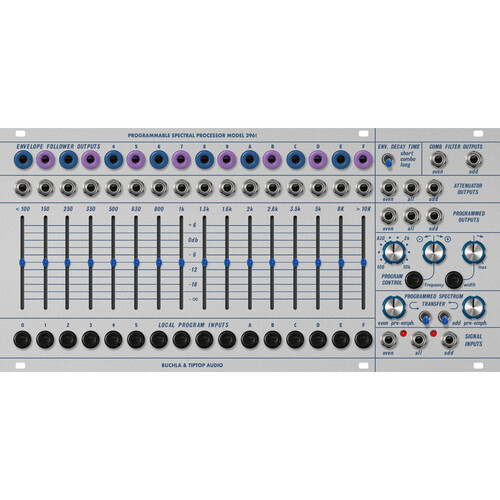
Shape your sounds with the Tiptop Audio Buchla Model 296t Programmable Spectral Processor, a 16-channel bandpass filter with built-in analysis and synthesis capabilities in a Eurorack module. The 296t can be used as a real-time performance filter, a programmable compound equalizer, or a spectral-transferring vocoder. The module ships with a ribbon power cable.Programmable Spectral Processor Model 296t The Programmable Spectral Processor is an elaborate set of filters with a number of different outputs and special functions. Perhaps its most obvious function is that of a sixteen band graphic equalizer. The sixteen bands are labeled in hex numerals (0 through F) at the top and bottom of the module and the center frequency of each band is indicated above each slider attenuator.Attenuator Outputs The signal input jacks, in the bottom right, offer the choice of putting a signal into the eight even numbered bands, all sixteen bands, or the eight odd bands.The Attenuator Outputs on the right of the module also offer Even, Odd, or All signal outputs. With a signal patched into the All signal input and taken out through the All attenuator output, the module functions just as a sixteen-band graphic equalizer. An attenuator at the very bottom will completely cut off any signal in that frequency band.The signal output jacks directly above each attenuator offer the signal present within that frequency band at 0 dB. These outputs are not affected by the attenuator's positions.The Comb Filter outputs offer signals from either all the Even or all the Odd bands and are also unaffected by the attenuators and are set at 0 dB.Control Voltage Outputs The control voltage outputs labeled Envelope Outputs are envelope follower outputs for each frequency band. In other words, the voltages from these outputs represent the amplitudes of the signals present within each band. The switch in the upper right selects Long, Combo, or Short envelope decay times. These outputs are not affected by the positions of the attenuators.Programmed Outputs The spectral processor can be voltage controlled in a variety of ways. The results of any control-voltage manipulation are presented to the programmed outputs. It is possible to sweep through the various frequency bands (much like a bandpass filter can sweep the frequency spectrum) using the left knob on the program control section.Spectral Bias The pair of knobs and switches labeled Programmed Spectrum Transfer have a function often associated with a Vocoder circuit. The left switch, when up, patches each Even envelope follower output into its neighboring Odd control voltage input. In effect this causes the spectral processor to analyze the signal present at the Even input and duplicate its frequency spectrum in the Odd bands. If the signal presented to the Odd input has a broad enough frequency spectrum itself, the Odd programmed outputs will match timbres with the Even signal. The right switch performs the same function going from Odd to Even.If a microphone signal is the signal being analyzed, a harmonically rich signal from an oscillator can be made to duplicate vowel sounds in speech (this is known as a Vocoder patch). For this to work best, the input signal requires special equalization, this is the purpose of the two knobs next to the switches. When turned to the right, they boost the treble range of the Even and Odd input signals respectively. Since they affect both the attenuator and programmed outputs, they should be turned down (to the left) unless setting up a vocoder patchLEDs The LEDs are driven from the Envelope Followers and help to indicate when a 10 V p-p signal (such as one from the 258t) hit right on the frequency of a specific band, pushing its envelope follower up to it's maximum CV value of 10V. When using a vocoder patch the output signal gain might be low, setting the VCO right at a center of a band using the LED helps maximize the gain output. These lights do not indicate distortion or o
Product Information
Availability:
In Stock