
- Products
-
Audio & Studio Equipment
See all
-
Cameras & Optics
See all
- Computers & Mobile Devices
- Drones & Aerial Imaging
-
Professional Video & AV
See all
- Security & Surveillance
- TVs & Entertainment
SubcategoriesSee all -
Audio & Studio Equipment
- About us
- Contact Us
- +1-888-219-0753
- Bulk Order

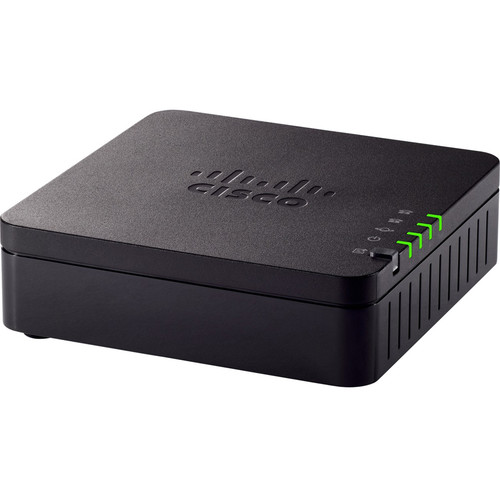
Cisco ATA 191 2-Port RJ11-to-Ethernet Multiplatform Analog Telephone Adapter
In Stock
SKU #
CIATA1913PWK
Mfr #
ATA191-3PW-K9
Manufacturer
Cisco
Description
Extend the investment of your analog communications equipment with this ATA 191 2-Port RJ11-to-Ethernet Multiplatform Analog Telephone Adapter from Cisco. This device features two RJ11 and a single RJ45 port, giving you the ability to connect legacy analog equipment to take advantage of IP telephony applications. It's designed to work with third-party call-control systems, and is not compatible with Cisco call-control systems. The two RJ11 FXS ports can be configured independently as two SIP (Session Initiation Protocol) registrations, and offers a variety of features to both enhance voice quality and network compatibility. Built-in audio pre-processing is engineered to offer clear and natural conversations with echo cancellation, voice activity detection, and comfort noise generation. It also enables IPv6 dual stack for migration to more advanced IPv6 protocol networks.Cloud Provisioning Enables zero-touch provisioning via TR-069 and XML configuration filesProblem Reporting (PRT) Serviceability is improved with a dedicated PRT button for problem reporting and log collectionSecurity Features A host of security solutions are features for both media and signaling: Password-protected system reset to factory default Password-protected administrator and user access authority Provisioning, configuration, and authentication HTTPS with factory-installed client certificate Advanced Encryption Standard (AES) encryption SIP over Transport Layer Security (TLS1.1 and TLS1.2) Secure (encrypted) calling using Secure RTP (sRTP) Encrypted configuration files Image authentication Secure boot Secure Shell (SSH)Networking Features & Support MAC address IPv4 only IPv6 only IPv4/IPv6 dual stack Session Initiation Protocol (SIP) Transmission Control Protocol (TCP) User Datagram Protocol (UDP) Real Time Protocol (RTP) Real Time Control Protocol (RTCP) HTTP HTTPS Trivial File Transfer Protocol (TFTP) Address Resolution Protocol (ARP) DNS A/AAAA and SRV records Dynamic Host Configuration Protocol (DHCP) client Internet Control Message Protocol (ICMP) Simple Network Time Protocol (SNTP) Cisco Discovery Protocol Link Layer Discovery Protocol (LLDP) Point-to-Point Protocol over Ethernet (PPPoE)Quality of Service (QoS) Features IEEE 802.1p/Q (QoS and VLAN tagging) Differentiated Services (DiffServ), Type of Service (ToS)Telephony Features Anonymous call and call blocking Call forwarding: No answer, busy, and all Call hold and resume Caller ID blocking Caller ID generation (name and number): Bellcore, BT, and European Telecommunications Standards Institute (ETSI) Caller ID with name and number Call pickup and group pickup Call transfer, call return, and call back on busy Call waiting Configurable ring frequency Configurable tones and cadences Disconnect tone Distinctive ringing: Calling and called number Do not disturb Forced Authorization Code (FAC)/Client Matter Code (CMC) Flash hook timer Hook flash event signaling Hotline and warm line calling Message Waiting Indicator (MWI) tones Music on hold Off-hook warning tone Polarity control Redial Selective and anonymous call rejection SIP redundancy Speed dial Streaming audio server: Up to 4 sessions Three-way conference calling with local mixing Tip and ring voltage adjustment setting Visual Messaging Waiting Indicator (VMWI) using Frequency Shift Keying (FSK) Network Address Translation (NAT) Session Traversal Utilities for NAT (STUN)Audio Features Codec: G.711 a-law, G.711 -law, G.729a, G.729ab, G.726 Codec name assignment Full-duplex audio Echo cancellation Voice activity detection Silence suppression Configurable silence threshold Comfort noise generation Adaptive jitter buffer Frame loss concealment Adjustable audio frames per packet Call progress tone generation Impedance and gain adjustment Dynamic audio payloadFax Features Real-time fax over IP via T.38 fax relay (Group 3) Fax pass-through via G.711 (Group 3) Fax tone detection and pass-through Automatic negotiation on transmission rateProvisioning &
Product Information
Availability:
In Stock