
- Products
-
Audio & Studio Equipment
See all
-
Cameras & Optics
See all
- Computers & Mobile Devices
- Drones & Aerial Imaging
-
Professional Video & AV
See all
- Security & Surveillance
- TVs & Entertainment
SubcategoriesSee all -
Audio & Studio Equipment
- About us
- Contact Us
- +1-888-219-0753
- Bulk Order

- Products
-
Audio & Studio Equipment
See all
-
Cameras & Optics
See all
- Computers & Mobile Devices
- Drones & Aerial Imaging
-
Professional Video & AV
See all
- Security & Surveillance
- TVs & Entertainment
SubcategoriesSee all -
Audio & Studio Equipment
- About us
- Contact Us
- +1-888-219-0753
- Bulk Order
HomeCatalogAudio & Studio EquipmentMusical InstrumentsKeyboardsintellijel Atlantix Analog Synth Voice Eurorack Module (42 HP)
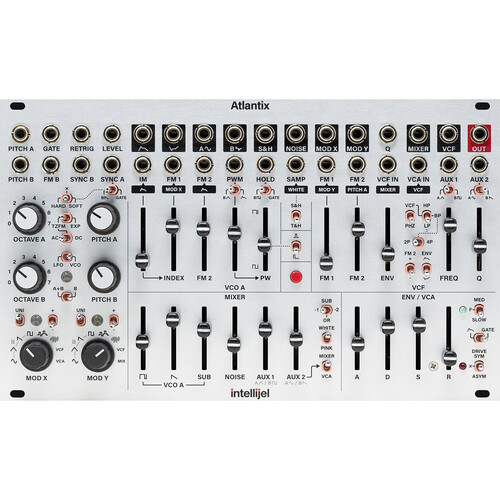
intellijel Atlantix Analog Synth Voice Eurorack Module (42 HP)
In Stock
SKU #
INATLANTIX3U
Mfr #
ATLANTIX-3U
Manufacturer
intellijel
Description
Explore new sonic territory with the intellijel Atlantix, a complete analog subtractive synthesizer voice in Eurorack format. The original Atlantis was inspired by the Roland SH-101. With its seemingly limited architecture, it produced various creative and musically useful sounds that have inspired generations of artists.The Atlantix is just as immediate for dialing in beautiful lead and bass sounds, but with the addition of new features and flexible patching options. The carefully conceived architecture and layout facilitate a lot of flexibility and hands-on control. The Atlantix offers every building block needed to start making patches in Eurorack, including VCOs, VCF, VCA, S&H, Noise, and Envelopes. The Atlantix is also compatible with the Atlx, an optional expander module, which provides 16 additional jacks from the Atlantix. The module includes a power ribbon cable and a set of mounting screws.At a Glance Cascaded 4-pole multimode filter with LP2, BP2, LP4, BP4, HP4, and Phaser modesTwo Triangle Core VCOsVCO A: Thru-Zero FM with INDEX and PWM, Hard/Soft Sync, Octave switchVCO B: Linear FM, LFO/VCO switch, Hard Sync, Octave switchSuboscillator with three modes spanning two octavesWhite and Pink noise sourcesSix-channel mixer comprising VCO A Waveforms, Sub, Noise, and two Aux inputsAux inputs have switched normals with sources from VCO A and B for quick paraphonic play without patchingMixer Aux 2 can be routed post-VCF / pre-VCAMod X and Y buses allow for quick modulation routing of VCO B, S&H, Noise, and feedback sources without patchingBoth Mod X and Y buses have polarity and level-shifting switchesAnalog ADSR envelope with three time ranges, manual gate, and level (velocity) inputPatchable Sample and Hold modulation sourceAsymmetric and symmetric output distortion modes20 sliders, 4 knobs, 27 toggles, and 2 rotary switches for expressive hands-on control32 jacks for creative and complex patching options16 additional jacks with the optional Atlx expanderOscillators-Advanced TZFM and Flexible Mixer The Atlantix uses two triangle core voltage controlled oscillators (VCO) which respond in a musically pleasing way to frequency modulation. The Atlantix primary VCO (VCO A) is capable of thru-zero frequency modulation and has a dedicated amplifier for controlling FM depth (FM INDEX). The modulation oscillator (VCO B) can be used as either an LFO or VCO. The highly flexible architecture allows you to route VCO B as a modulation source, or stack it as a secondary VCO, all by the flick of a switch or slider. VCO B also has a bonus spike waveform output which is a square wave with fixed HPF, similar to the Buchla Easel. Both oscillators track very precisely over eight or more octaves.In the mixer section, you can adjust the balance of the primary oscillator's waveforms, sub-oscillator noise, and two auxiliary inputs that are normalled to additional VCO A waveforms or VCO B waveforms. The auxiliary inputs also allow you to patch other external signals into the mix.The second Auxiliary input has a switch that allows you to route the source between the mixer sum or directly into the VCA (post VCF). The latter is a way to pass an unfiltered fundamental signal to the final VCA stage and then blend it with filtered audio from the VCF. This draws inspiration from the architecture of the CS-80 where a sinewave is mixed with the filtered audio to make glassy tones with some added harmonics. Multimode Filter The filter section (VCF) is a discrete cascaded 4-pole multimode filter with low-pass, band-pass, high-pass, and phaser (multi-notch) modes. The filter can self-oscillate, which produces a very clean sinewave that also tracks 1V/oct. The VCF has three frequency modulation sources, two of which are normalled to the external pitch and envelope, and have switches for polarity.Add Atlx for dedicated outputs from each mode.Envelope-Classic ADSR The envelope section is an analog ADSR with three timing ranges: slow, medium, and fast. It c
Product Information
Availability:
In Stock