
- Products
-
Audio & Studio Equipment
See all
-
Cameras & Optics
See all
- Computers & Mobile Devices
- Drones & Aerial Imaging
-
Professional Video & AV
See all
- Security & Surveillance
- TVs & Entertainment
SubcategoriesSee all -
Audio & Studio Equipment
- About us
- Contact Us
- +1-888-219-0753
- Bulk Order

- Products
-
Audio & Studio Equipment
See all
-
Cameras & Optics
See all
- Computers & Mobile Devices
- Drones & Aerial Imaging
-
Professional Video & AV
See all
- Security & Surveillance
- TVs & Entertainment
SubcategoriesSee all -
Audio & Studio Equipment
- About us
- Contact Us
- +1-888-219-0753
- Bulk Order
HomeCatalogComputers & Mobile DevicesNetworkingAll Wireless NetworkingASUS ZenWiFi BT8 BE14000 Wireless Tri-Band Multi-Gig Mesh Wi-Fi Module (White)
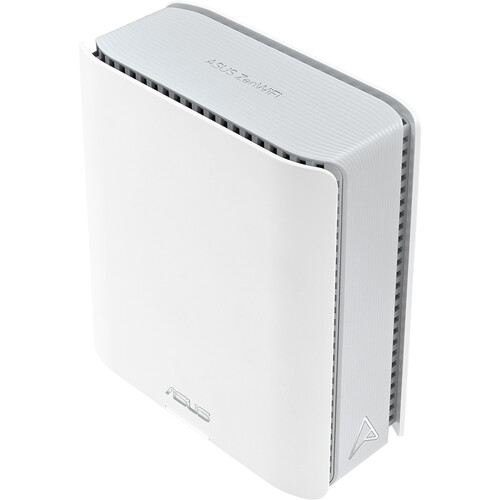
ASUS ZenWiFi BT8 BE14000 Wireless Tri-Band Multi-Gig Mesh Wi-Fi Module (White)
In Stock
SKU #
ASZWIFIBT81P
Mfr #
BT8 (W-1-PK)
Manufacturer
ASUS
Description
Enhance your home or office with exceptionally fast wireless connections with the ASUS ZenWiFi BT8 BE14000 Wireless Tri-Band Multi-Gig Mesh Wi-Fi Module. Configurable as a either router or satellite to an existing mesh network, this white Wi-Fi 7 (802.11be) tri-band module is designed to deliver up to 13.7 Gb/s throughput over the 2.4 GHz, 5 GHz, and 6 GHz bands, providing smooth 8K video streaming and low-latency gaming experiences. Providing up to 3000 square feet of coverage, this module may be integrated into a mesh network to operate with a single network ID (SSID), delivering seamless connectivity as you move from room to room. With 2.5G WAN connectivity, you can take advantage of multi-Gig internet services. A 2.5G LAN port is also available alongside two Gigabit-speed LAN ports, allowing you to connect computers, NAS enclosures, and other wired network devices. Connecting a 4G LTE or 5G LTE mobile network device to the USB-A 3.2 Gen 1 port will ensure internet access if the main service goes offline. Use the ASUS Router app on your Android or iOS device to configure your network, including guest logins and parental controls. You can also connect to your home network via a VPN for additional security when using a public Wi-Fi hotspot. Worry-Free Smart Home MeshWi-Fi 7 Quad-Band Mesh Featuring seven internal antennas, the ASUS ZenWiFi BT8 is designed to deliver a total tri-band throughput of up to 13,654 Mb/s with compatible devices. Beamforming, MU-MIMO, OFDMA, and Tri-Band Multilink technologies help to provide strong, long-range connections.Comprehensive MLO Support Multi-Link Operation (MLO) enables buffering-free connections by intelligently combining and switching between the 2.4 GHz, 5 GHz, and 6 GHz bands.Ultrawide 320 MHz Bandwidth Wi-Fi 7 introduces the ultrawide 320 MHz channel bandwidth in the 6 GHz band, doubling data transmission capacity.Efficient 4096-QAM Transmission 4K-QAM technology boosts data transmission rates by up to 20% over Wi-Fi 6/6E due to its higher QAM, which packs signals more densely, allowing for more data to be uploaded and downloaded in the same time frame as before.
Product Information
Availability:
In Stock