
- Products
-
Audio & Studio Equipment
See all
-
Cameras & Optics
See all
- Computers & Mobile Devices
- Drones & Aerial Imaging
-
Professional Video & AV
See all
- Security & Surveillance
- TVs & Entertainment
SubcategoriesSee all -
Audio & Studio Equipment
- About us
- Contact Us
- +1-888-219-0753
- Bulk Order

- Products
-
Audio & Studio Equipment
See all
-
Cameras & Optics
See all
- Computers & Mobile Devices
- Drones & Aerial Imaging
-
Professional Video & AV
See all
- Security & Surveillance
- TVs & Entertainment
SubcategoriesSee all -
Audio & Studio Equipment
- About us
- Contact Us
- +1-888-219-0753
- Bulk Order
HomeCatalogAudio & Studio EquipmentAudio for VideoAll Field Mixers & AccessoriesBeachtek DXA-GO Two-Channel Adapter/Bracket for GO Wireless Receiver and Camera
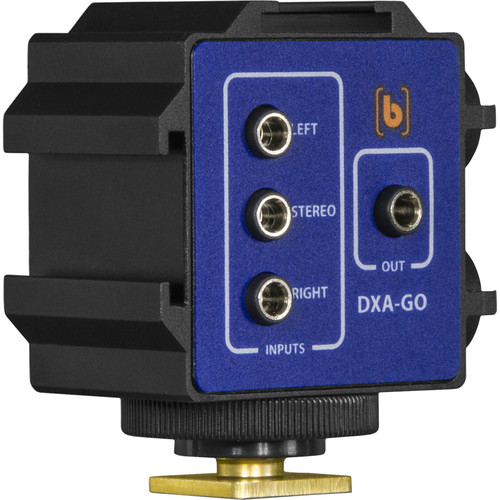
Beachtek DXA-GO Two-Channel Adapter/Bracket for GO Wireless Receiver and Camera
In Stock
SKU #
BEDXAGO
Mfr #
DXA-GO
Manufacturer
Beachtek
Description
The Beachtek DXA-GO is a two-channel audio adapter and bracket designed to help DSLR and mirrorless shooters get the most out of the Rode GO wireless mic system. This lightweight, compact device mounts to any standard camera shoe and lets you attach the GO receiver just above the camera facing you for easy access.Two more mounts can accommodate additional accessories, such as another wireless receiver or a self-powered camera-mountable microphone to take advantage of the adapter's second channel. The DXA-GO's passive circuitry is noise free and requires no batteries or power to operate. A 3.5mm TRS stereo output cable is included.Easily Mount, Connect, and Use the GO and a Second Mic Securely mounts the GO receiver to your cameraTwo auxiliary mounts let you attach an additional receiver, mic, or lighting accessoryTwo mono 3.5mm inputs and one stereo 3.5mm input provide versatile optionsCan be used with most wireless mics and high-output self-powered micsReal volume knobs mean no hunting through multilayer menus trying to find or change settingsSince the audio is recorded directly to the camera, it will always be in sync with the videoNoise-Free & Battery-Free Operation With passive circuity and no electronics to get in the way, the DXA-GO provides clean, noise-free audio directly to the cameraThe adapter is virtually unclipable and offers an extremely wide dynamic rangeWorks with most wireless receivers or microphones that do not require additional amplification or plug-in powerAdjust Recording Levels Dual trim controls allow you to easily attenuate each channel independentlyEasily accessible detented knob controls provide drift-free operation and precise volume attenuationThe bracketing feature lets you set two different levels on both channels when using a single mono mic giving you a backup in case one channel is blown outMono or Stereo Operation Output can be set to dual mono or stereoSet the output mode to stereo when connecting two mono mics or one stereo mic on two channelsSet the output mode to mono when using one mic for dual-channel mono recording
Product Information
Availability:
In Stock