
- Products
-
Audio & Studio Equipment
See all
-
Cameras & Optics
See all
- Computers & Mobile Devices
- Drones & Aerial Imaging
-
Professional Video & AV
See all
- Security & Surveillance
- TVs & Entertainment
SubcategoriesSee all -
Audio & Studio Equipment
- About us
- Contact Us
- +1-888-219-0753
- Bulk Order

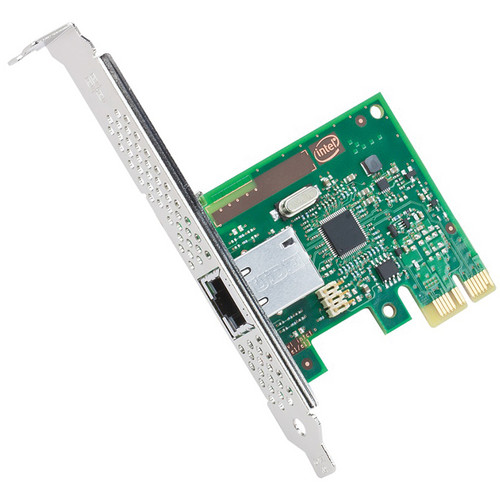
Intel Single-Port Gigabit Ethernet Server Adapter I210 (Single Pack)
In Stock
SKU #
INI210RSA
Mfr #
I210T1
Manufacturer
Intel
Description
The Single-Port Gigabit Ethernet Server Adapter I210 (Single Pack) from Intel is a low-halogen PCIe 10/100/1000 Ethernet adapter, designed for entry-level servers and audio-video applications. It offers innovative power management features, including Energy Efficient Ethernet (EEE), DMA Coalescing, ultra-compact design, and a ventilated bracket for increased efficiency and reduced power consumption. It supports PCIe Gen 2.1 (2.5 GT/s) and IEEE 802.1Qav Audio-Video Bridging (AVB) for tightly controlled media stream synchronization, buffering, and reservation. The I210 Ethernet Controller supports IEEE 802.1Qav Audio-Video Bridging (AVB) for customers requiring tightly controlled media stream synchronization, buffering, and reservation. 802.1Qav is part of the AVB specification, which provides a way to bounded latency and latency variation for time sensitive traffic. AVB includes timing and synchronization for time specific applications, (802.1AS) Stream Reservation (SR) protocol, to guarantee the resources needed for Audio/Video (AV) streams (802.1Qat). It also includes forwarding and queuing enhancements for time sensitive streams (802.1Qav). The adapter is low halogen and completely lead-free to reduce the environmental impact. It maximizes airflow and cooling with a ventilated bracket. This server adapter contains four transmit and four receive queues. These queues offer ECC memory for improved data reliability. The adapter efficiently manages packets with minimum latency by combining parallel and pipelined logic architectures, optimized for these independent transmit and receive queues. These queues, combined with Receive Side Scaling (RSS) and Message Signal Interrupt Extension (MSI-X) support, optimize the performance on servers with multi-core processors. Energy Efficient Ethernet (EEE) reduces the power consumption of an Ethernet connection during periods of low network activity by negotiating with a compliant EEE switch port to transition to a Low Power Idle (LPI) state. EEE is supported for both 1000BASE-T and 100BASE-TX. DMA request is initiated to place the packet into host (or server) memory, when a packet arrives at the adapter. This transaction wakes up the processor, memory, and other system components from a lower power state in order to perform the tasks required to handle the incoming packet. Based on the configurable DMAC settings, incoming packets are buffered momentarily before any DMA calls are made. This enables the controller to intelligently identify opportunities to batch multiple packets together, so that when components are wakened from lower power states, they can efficiently handle the batched packets at the same time. It also enables the platform components to remain in lower power states longer, which can reduce platform energy consumption. DMAC synchronizes DMA calls across all controller ports to ensure maximum power savings. Ethernet FeaturesAudio-Video Bridging (AVB) Support (802.1Qav) Dedicated Tx and Rx queues for AVB trafficNone Supports forwarding and queuing enhancements for time-sensitive streamsNone Supports time-based transmissionIEEE 802.3 Auto-Negotiation Automatic link configuration for speed duplex and flow controlCompliant with 1 Gb/s Ethernet IEEE 802.3, 802.3u, 802.3ab PHY Specifications Robust operation over installed base of Cat 5 twisted-pair cablingIntegrated PHY for 10/100/1000 Mb/s for Multi-Speed, Full, and Half-Duplex Smaller footprint and lower power dissipation compared to multiple discrete MAC and PHYsIEEE 802.3x and IEEE 802.3z Compliant IEEE 802.3x and IEEE 802.3z compliant flow control support, with software-controllable Rx thresholds and Tx pause framesNone Local control of network congestion levelsNone Frame loss reduced from receive overrunsAutomatic Cross-Over Detection Function (MDI/MDI-X) The PHY automatically detects which application is being used and configures itself accordinglyIEEE 1588 Protocol and 802.1AS Implementation Time-stamping and synchronizat
Product Information
Country of Origin:
TW
Availability:
In Stock
Unit of Measure:
EA
Weight:
1