
- Products
-
Audio & Studio Equipment
See all
-
Cameras & Optics
See all
- Computers & Mobile Devices
- Drones & Aerial Imaging
-
Professional Video & AV
See all
- Security & Surveillance
- TVs & Entertainment
SubcategoriesSee all -
Audio & Studio Equipment
- About us
- Contact Us
- +1-888-219-0753
- Bulk Order

- Products
-
Audio & Studio Equipment
See all
-
Cameras & Optics
See all
- Computers & Mobile Devices
- Drones & Aerial Imaging
-
Professional Video & AV
See all
- Security & Surveillance
- TVs & Entertainment
SubcategoriesSee all -
Audio & Studio Equipment
- About us
- Contact Us
- +1-888-219-0753
- Bulk Order
HomeCatalogComputers & Mobile DevicesNetworkingAll Wired NetworkingHP 2930F 48-Port Gigabit Ethernet PoE+ Switch with Four 1 Gb/s SFP Ports
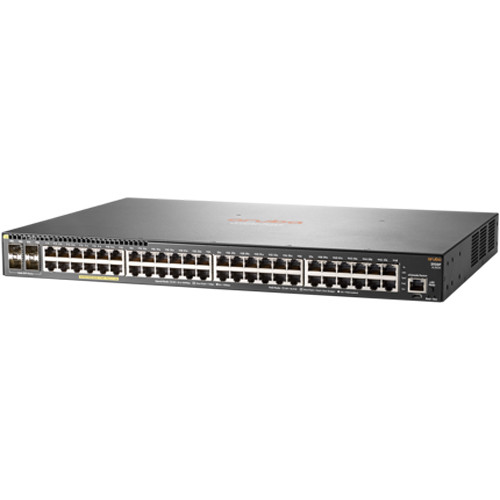
HP 2930F 48-Port Gigabit Ethernet PoE+ Switch with Four 1 Gb/s SFP Ports
In Stock
SKU #
HEJL262A
Mfr #
JL262A#ABA
Manufacturer
HP
Description
Ideal for administrators looking to quickly deploy, manage, and maintain networks geared toward both wired and wireless users, the Aruba 2930F 48-Port Gigabit Ethernet PoE+ Switch with 1 Gb/s SFP Ports is an easy-to-install Layer-3 access switch equipped with 48 Gigabit Ethernet ports, four 1 Gb/s SFP uplink ports, and up to 77.4 Mpps total throughput.Boasting OpenFlow 1.0 and 1.3 functionality, which allows for intelligent traffic routing by enabling network controllers to remotely manage the path of data packets, the Aruba 2930F supports RIP (Routing Information Protocol) and Access OSPF (Open Shortest Path First) Routing, access control lists (ACLs), and Quality of Service (QoS) features such as IEEE 802.1p traffic prioritization and ingress rate limiting.Installation is simple thanks to the 2930F's Zero Touch Provisioning support, while the Aruba ClearPass Policy Manager allows for unified wired and wireless policies.Software-Defined Networking Supports OpenFlow 1.0 and 1.3 specifications to enable SDN (Software-Defined Networking) by allowing separation of the data (packet forwarding) and control (routing decision) paths.Unified Wired and Wireless Supports unified wired and wireless policies using Aruba ClearPass Policy Manager. Switch auto-configuration automatically configures switch for different settings such as VLAN, CoS (Class of Service), and PoE (for switches with PoE support) when an Aruba access point is detected. Local user role defines a set of switch-based policies in areas such as security, authentication, and QoS. A user role can be assigned to a group of users or devices, using switch configuration or ClearPass. Per-port tunneled node provides a secured tunnel to transport network traffic on a per-port basis to an Aruba Controller. Authentication and network policies can be applied and enforced at the controller. HTTP redirect function supports Intelligent Management Center (IMC) "bring your own device" (BYOD) solution.Quality of Service (QoS) Traffic prioritization (IEEE 802.1p) allows real-time traffic classification into eight priority levels mapped to eight queues. Layer 4 prioritization enables prioritization based on TCP/UDP port numbers. Class of Service (CoS) sets the IEEE 802.1p priority tag based on IP address, IP Type of Service (ToS), Layer 3 protocol, TCP/UDP port number, source port, and DiffServ. Rate limiting sets per-port ingress-enforced maximums and per-port, per-queue minimums Large buffers provide smooth congestion management.Connectivity Auto-MDIX provides automatic adjustments for straight-through or crossover cables on all 10/100/1000 Mb/s ports. IEEE 802.3at Power over Ethernet (PoE+) provides up to 30 W per port that allows support of PoE-enabled devices such as IP phones, wireless access points, and security cameras, as well as any IEEE 802.3af-compliant end device; eliminates the cost of additional electrical cabling and circuits that would otherwise be necessary in IP phone and WLAN deployments.IPv6 Support IPv6 host enables switches to be managed in an IPv6 network. Dual-stack (IPv4 and IPv6) transitions from IPv4 to IPv6, supporting connectivity for both protocols. MLD (Multicast Listener Discovery) snooping forwards IPv6 multicast traffic to the appropriate interface. IPv6 ACL/QoS supports ACL (Access Control List) and QoS (Quality of Service) for IPv6 network traffic. IPv6 routing supports static and RIPng (Router Information Protocol next generation) protocols. Security provides RA (Router Advertisement) guard, DHCPv6 protection, dynamic IPv6 lockdown, and ND (Neighbor Discovery) snooping.Performance Energy-efficient Ethernet (EEE) support reduces power consumption in accordance with IEEE 802.3az. Aruba ASIC (Application-Specific Integrated Circuit) architecture is designed with Aruba ASIC for low latency, increased packet buffering, and adaptive power consumption. Selectable queue configurations allows for increased performance by selecting the number of queues and associ
Product Information
Availability:
In Stock