
- Products
-
Audio & Studio Equipment
See all
-
Cameras & Optics
See all
- Computers & Mobile Devices
- Drones & Aerial Imaging
-
Professional Video & AV
See all
- Security & Surveillance
- TVs & Entertainment
SubcategoriesSee all -
Audio & Studio Equipment
- About us
- Contact Us
- +1-888-219-0753
- Bulk Order

- Products
-
Audio & Studio Equipment
See all
-
Cameras & Optics
See all
- Computers & Mobile Devices
- Drones & Aerial Imaging
-
Professional Video & AV
See all
- Security & Surveillance
- TVs & Entertainment
SubcategoriesSee all -
Audio & Studio Equipment
- About us
- Contact Us
- +1-888-219-0753
- Bulk Order
HomeCatalogAudio & Studio EquipmentMusical InstrumentsKeyboards4ms Percussion Interface + Expander Eurorack Modules (4+4 HP)
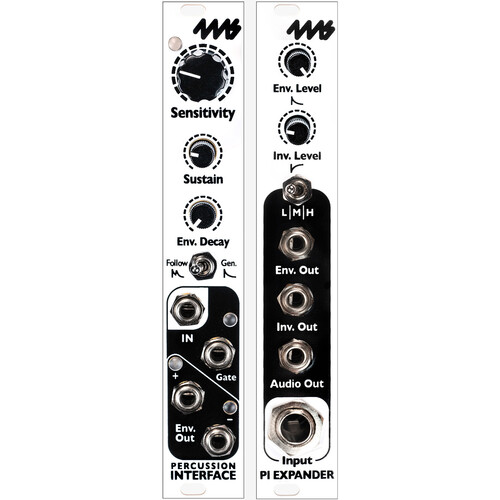
4ms Percussion Interface + Expander Eurorack Modules (4+4 HP)
In Stock
SKU #
4MPIEXP
Mfr #
PI+EXP
Manufacturer
4ms
Description
Convert microphone, instrument, line, and modular signals into CV and clock/gate signals with the 4ms Percussion Interface + Expander, a pair of Eurorack modules capable of generating gate and envelopes from almost any audio source including acoustic drums, samplers, and drum machines.The Percussion Interface and Expander work well for synchronizing sequencers or other modules to the rhythm of an audio track or live percussion. The modules can simultaneously be used as a preamp for microphone- or line-level signals, while generating inverted envelopes useful for side-chaining. The Expander requires the main PI module and adds three gain stage options, a modular-level audio output jack, a 1/4" input jack, and envelope attenuation capabilities. The PI + PI Expander modules ship with a ribbon power cable and mounting screws.Percussion Interface and Expander Overview Sensitivity knob, Low|Medium|High gain switch, and clipping LEDSustain control to prevent misfires, increase gate length, and control the envelopeEnvelope decay controlNon-inverted and inverted envelope outputs, useful for side chainingFour envelope outputs: two attenuated with independent attenuators, and two non-attenuatedEnvelope following or generation modesGate output for clocking sequencers or any unit with a clock or trigger inputCompatibility with drums, samplers, microphones, drum machines, etc.1/4" input jackPercussion Interface Controls and Jacks In Jack: Accepts a wide range of signals from microphones directed at acoustic sounds such as drums, electronic drum machines, samplers, guitars, synthesizers, line-level equipment, or any other audio source. With the exception of microphones that require power (phantom-powered and electret microphones), any microphone or piezo transducer will work. The In jack is mono but will work with a stereo or balanced cable.Sensitivity Knob and Light: The Sensitivity knob controls how much the input signal is boosted. At maximum gain settings, the smallest input signal that will trigger a gate output is roughly 5 to 10mV. The Sensitivity range is determined by the position of the L|M|H switch on the PI Expander. The light will show blue when a signal is detected and will gradually turn red as the unit begins to clip at the input. Clipping may result in undesired gates or envelopes, also known as misfires.Sustain Knob: The Sustain knob controls the pulse width of the gate output as well as the sustain time of the envelope while in Gen. mode. When the gate output is high, no additional triggers will be generated, so misfires can be reduced. The minimum pulse width is 5 ms, and the maximum is 0.5 sec.Envelope Decay Knob: The Env. Decay knob sets the decay time of the envelope. The envelope has an exponential curve.Follow/Gen. Switch: The Follow/Gen. switch selects between two envelope modes. In Gen. mode, the envelope has a sharp attack, followed by a sustain period and an exponential decay.The attack and sustain period are synchronized with the gate output, that is, the envelope remains high as long as the gate is high. In Follow mode, the envelope responds to the peaks and valleys of the input signal and ignores the gate.Gate Out Jack and LED Indicator: The Gate jack outputs a pulse which is generated from the input signal. It can be used to clock sequencers and trigger other modules. When high, the Gate jack outputs 8V, indicated by the white light above the jack.Envelope Output Jacks: The top left jack, marked by the + symbol, outputs a 0V to 9V envelope when triggered by the input signal. The blue light above the jack indicates the envelope s level. The jack at the bottom right, indicated by the symbol, outputs an inverted copy of the envelope. When the envelope is at rest, this jack outputs 9V and the green light above the jack is fully bright. When the envelope is triggered, it falls to a minimum of 0V and the green light will dim. This envelope is useful for side-chaining.Percussion Interface Expander Controls and Jacks
Product Information
Availability:
In Stock